
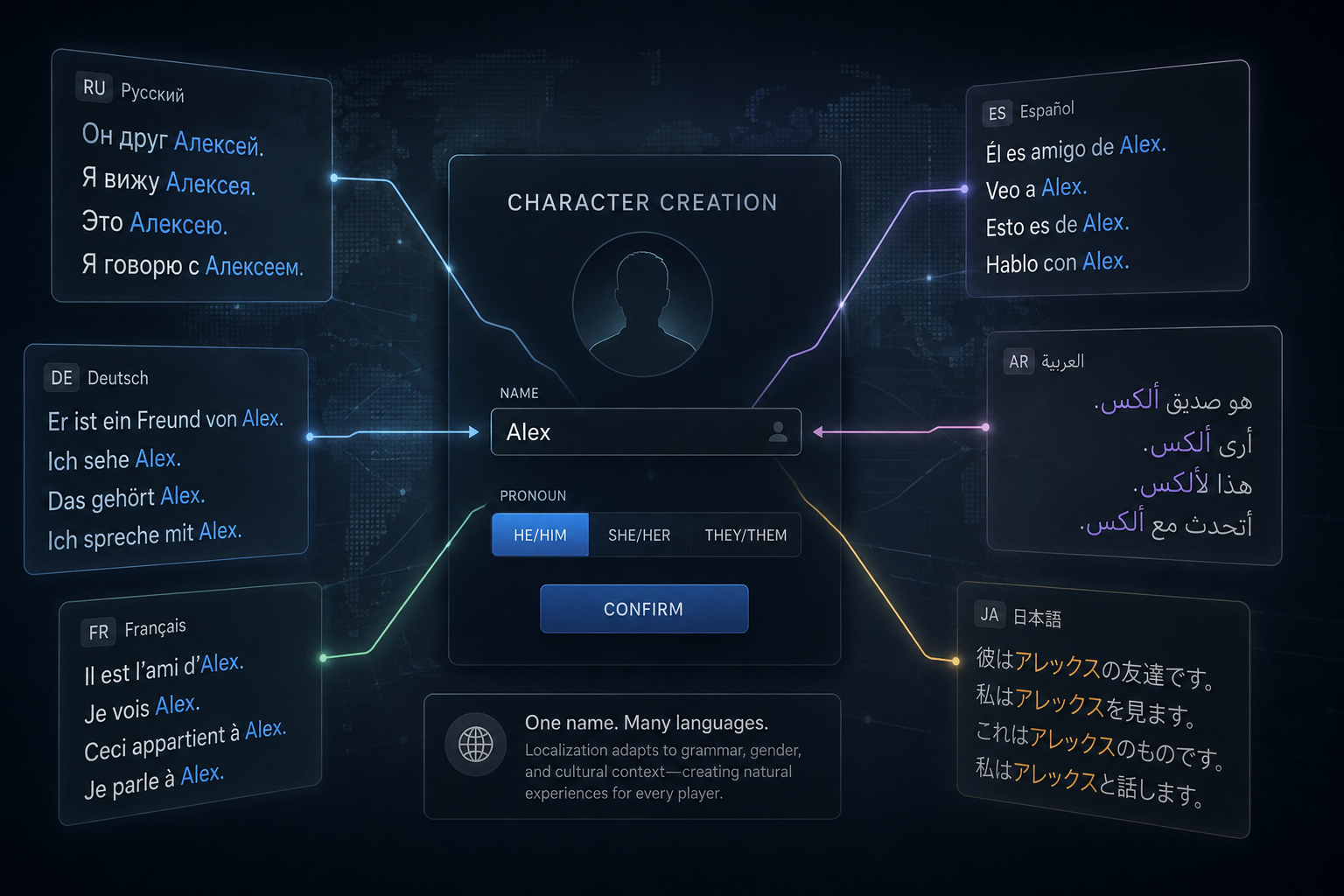
A player types their name into a character creation screen, picks a pronoun, and starts playing. It takes ten seconds. For the localization team behind that game, it can mean rebuilding how the entire script handles grammar — because in dozens of languages, a name and a pronoun aren’t just labels. They’re grammatical triggers that change verb endings, adjective forms, and sentence structure throughout the whole game.
Why “He Said” Isn’t the Same Problem Everywhere
English localization teams have it relatively easy. “You are strong” doesn’t change whether the player is male, female, or non-binary. But in German, French, Russian, Polish, and dozens of other languages, adjectives and past-tense verbs agree with gender. “You were tired” in Russian requires a different verb ending depending on whether “you” is grammatically male or female — and if the player’s pronoun is unknown at the time of writing, or user-selected outside the binary, there’s no single correct line to write.
This is the real localization cost of player-named, player-gendered characters: it’s not a translation problem, it’s a systems problem. Studios can’t just translate a script — they have to design a script architecture that supports grammatical branching for every gendered sentence, in every language that requires it, before a single line is voiced.
Where Voice Localization Hits a Wall Text Doesn’t
Text localization can brute-force this with conditional variables — swap in the right adjective ending based on a gender flag. Voice localization can’t fake it that easily. If a line needs to sound different for a male-voiced and female-voiced protagonist, that’s two separate recording sessions, two separate performances, and often two separate voice actors — multiplied across every localized language. A game that ships with three pronoun options and eight target languages isn’t looking at 8 dubs. In gendered languages, it’s potentially looking at 24 distinct VO passes for every gender-dependent line in the script.
Studios that don’t plan for this early tend to discover it the expensive way: mid-production, when a narrative designer writes a throwaway gendered line for flavor text, and localization has to flag that one sentence as a scheduling and budget problem across half the target languages.
Designing Around the Problem, Not Patching It Later
The studios that handle this well treat grammatical gender as a scripting constraint from day one, not a localization afterthought. That means auditing gendered language rules per target market before writing dialogue, flagging gender-agreement lines in the script for early localization review, and building VO recording schedules that account for multiple gendered takes per language from the start — rather than retrofitting them after the English version is locked.
Player-named, player-gendered characters are a defining feature of modern RPGs and live-service games. But every studio that ships one is quietly signing up for a localization workload that scales with grammatical complexity, not just word count. The games that get this right don’t treat pronoun choice as a UI setting — they treat it as a script architecture decision with real downstream cost in voice localization.


