
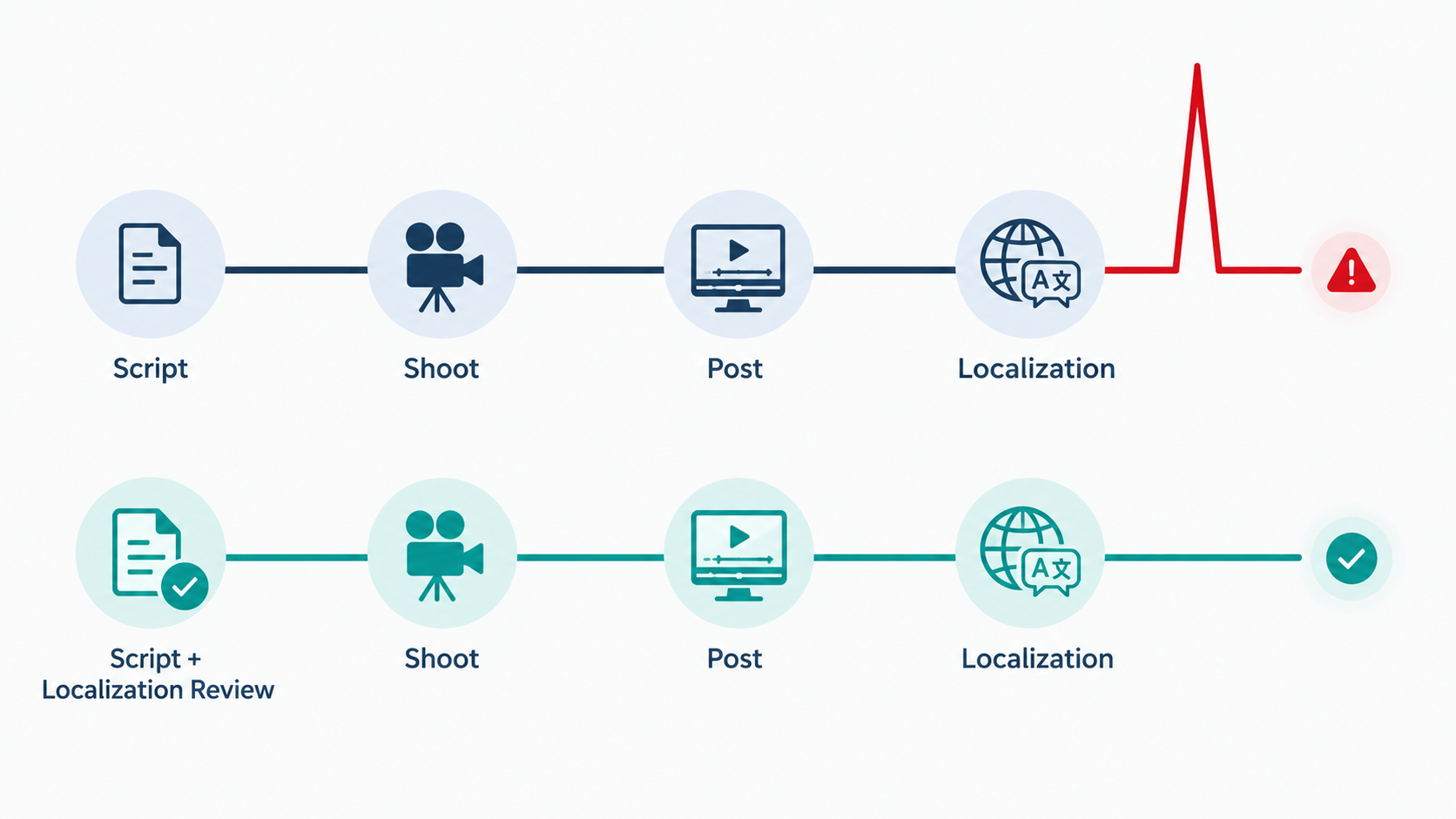
For most of the industry’s history, localization has been the last stop before delivery — a process that happens to a finished script, after every creative decision has already been locked. That order is starting to break down. A growing number of studios across film, TV, and games are pulling localization into pre-production, treating dubbing constraints as a writing-room concern rather than a downstream fix. It’s a small shift in timing with a large effect on cost, quality, and how many territories a title can actually reach on schedule.
The Cost of Writing Localization-Blind
A script written without localization in mind tends to accumulate small landmines: jokes built entirely on wordplay, character names that don’t survive translation, visual gags timed to English syllable counts, gendered dialogue that assumes a single pronoun. None of these are dealbreakers individually. But discovered one at a time, late, across a dozen languages, they add up to the slow, expensive rewrite-and-repair cycle that localization teams have quietly absorbed for decades.
Post-production localization was built to solve exactly this — adapt what’s already written. But adaptation has limits. You can rework a joke, but you can’t always fix a scene built around a pun that simply doesn’t translate. You can flag a gendered line, but if the animation, lip-sync, or voice direction was already locked around one version, the fix is now a production problem, not a translation one.
What “Localization-First” Actually Looks Like
Studios adopting this approach aren’t asking writers to localize the script themselves. They’re bringing localization leads into early creative meetings — not to approve dialogue, but to flag structural risks before they’re built into production. That includes auditing scripts for jokes and idioms that won’t travel, flagging gendered or culturally specific lines for early review, and building character and world-building choices (names, honorifics, visual text) with an eye toward how they’ll hold up once translated and voiced.
The goal isn’t a blander, more “translatable” . It’s catching the handful of choices per project that would otherwise force a costly rebuild later — while leaving everything else exactly as creatively ambitious as it was going to be anyway.
Why This Is Happening Now, Not Five Years Ago
Two pressures are driving the shift at the same time. Global day-and-date releases have compressed delivery windows so tightly that there’s no longer room for late-stage localization surprises — a script problem discovered in week two of post can blow a simultaneous release across every territory, not just one. And the sheer number of target languages and markets studios now localize into has made the old “fix it later” model too expensive to scale. Catching a structural problem in a table read costs a conversation. Catching it in ADR costs a reshoot, a re-record, or a delayed launch.
The Long-Term Shift
This isn’t localization taking over the writers’ room. It’s localization earning a seat at the table earlier, the same way accessibility and legal review moved upstream once studios realized fixing problems after the fact was more expensive than preventing them. The studios treating localization as a pre-production discipline aren’t just saving money — they’re building content that was designed, from the first draft, to actually work everywhere it’s going to be watched.


