
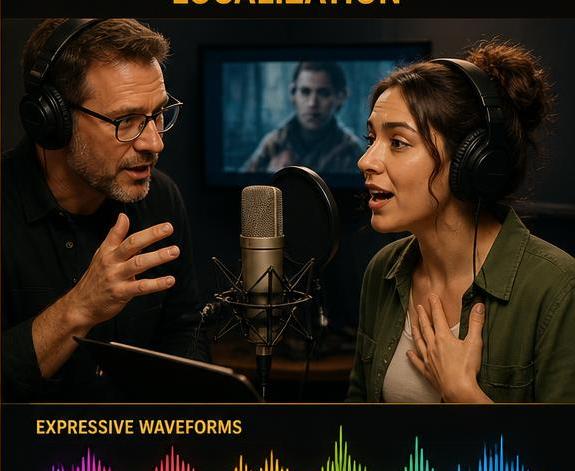
Localization has traditionally been measured by accuracy. For years, success meant delivering faithful translations, synchronized dialogue, and technically polished recordings. While these fundamentals remain essential, studios and content owners are increasingly looking for something more: performances that resonate emotionally with audiences in every language.
As a result, performance-directed localization is emerging as a premium service—one that combines expert voice direction, emotional supervision, and localization to recreate not just what characters say, but how they make audiences feel.
Translation is only the beginning
Even a perfectly translated script can fall flat if the performance doesn’t match the emotional intent of the original.
Dialogue is shaped by far more than words alone. Tone, pacing, hesitation, intensity, and vocal rhythm all influence how a scene is perceived.
A localized line may be linguistically correct, yet still feel unnatural if the actor’s delivery lacks the subtle emotional cues present in the original performance.
This is why more studios are investing in creative voice direction rather than treating recording sessions as simple script-reading exercises.
Voice directors have become creative partners
In performance-directed localization, voice directors play a much larger role than ensuring technical accuracy.
They work closely with actors to preserve:
- emotional intensity
- character relationships
- dramatic pacing
- comedic timing
- vocal consistency
Rather than instructing actors to simply match lip movements or reading speed, directors help recreate the emotional journey of each scene.
This approach is particularly valuable for narrative-driven games, prestige television, animated films, and cinematic streaming productions, where dialogue often carries the heart of the story.
Emotional supervision improves consistency
Large productions frequently involve multiple recording sessions, different actors, and several languages.
Without consistent creative oversight, performances can begin to drift.
One character may sound more energetic than intended, while another gradually loses the personality established earlier in the project.
Performance supervision helps maintain consistency across:
- episodes
- sequels
- downloadable content
- live-service updates
- multilingual releases
Instead of evaluating dialogue solely for pronunciation or translation accuracy, directors also assess whether the emotional performance remains true to the original creative vision.
Premium content demands premium localization
Audiences have become increasingly sensitive to vocal performances.
As discussed in Force Media’s article The Rise of Whisper-Accurate Dubbing for Prestige Drama, viewers now notice subtle details such as breathing, vocal texture, and emotional restraint.
Accordingly, studios are beginning to differentiate between standard localization and premium localization services that include dedicated creative direction throughout production.
For high-profile projects, that additional layer of supervision can significantly improve the final viewing or gameplay experience.
A growing competitive advantage
As global content continues to expand, premium localization services are becoming an important way for studios to distinguish their productions.
Performance-directed localization helps ensure that audiences in every market experience the same emotional impact as the original audience.
It transforms localization from a technical process into a creative collaboration.
For content owners, that means stronger audience engagement.
For viewers and players, it means performances that feel authentic rather than translated.
And for localization studios, it represents the next evolution of premium audio production—where success is measured not only by linguistic accuracy, but by emotional authenticity.


