
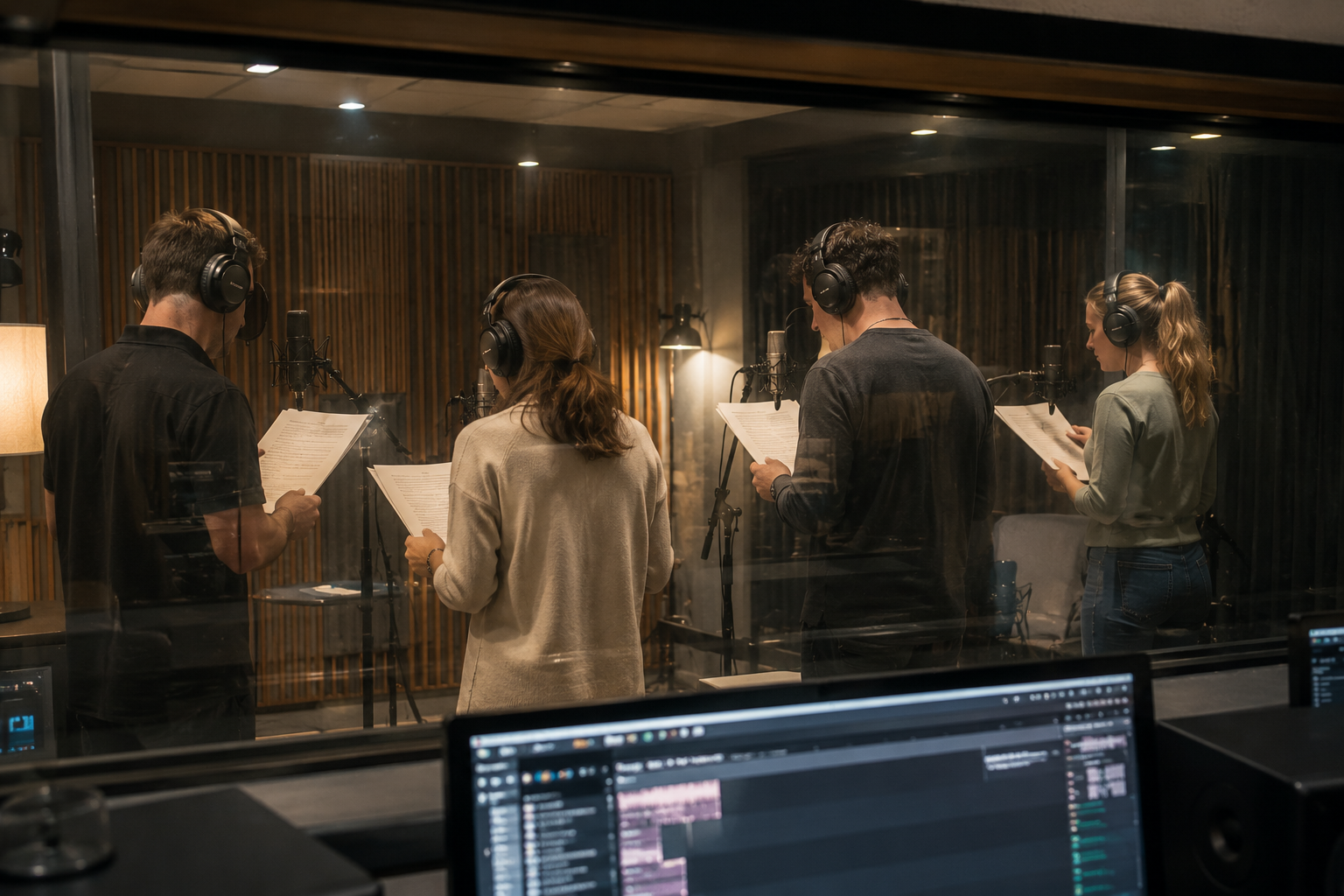
Casting an original actor is, in some ways, the easy part. A director hears one voice, matches it against one character, and moves on. Dub casting works backwards — you’re not looking for a voice, you’re trying to rebuild an entire cast’s chemistry in a language it was never written in. Get one voice wrong, and it’s not just that character who suffers. The whole ensemble stops feeling like a family, a team, or a rivalry, and starts feeling like strangers reading lines in the same room.
The Problem Nobody Talks About: Relation Casting
Most conversations about dub voice casting focus on the single-actor question: does this voice sound like the character? But anyone who’s sat through a full ADR session for an ensemble show knows the harder question is relational. Does the older brother’s voice actually sound older than the younger one’s? Does the tired detective sound tired next to his sharp-tongued partner, or do they just sound like two separate recordings stitched together?
This is where a lot of localization falls short. Studios cast character-by-character, against a reference clip, in isolation — and the individual matches can be perfect while the group dynamic falls flat. As Deepdub’s casting overview notes, dubbing casting decisions have to account for how a voice actor’s delivery works in relation to the rest of the cast, not just the character description on paper. Voice actors need contrast as much as accuracy. A cast that all pitches in the same register, regardless of how well each performer nails their own character, produces a flat, indistinct dub, even when every single match “passes” on its own.
Age, Timbre, and the Illusion of Time Passing
Age consistency compounds the problem. A character who’s supposed to sound 12 years older than their sibling needs an actor whose timbre — not just tone of voice, but the physical texture of it — reads as older, not just performed as older. Actors can act tired, act young, act gravelly. But timbre is much harder to fake convincingly across a full season, let alone a multi-season, multi-region franchise. A dub cast that can’t hold that age gap consistently ends up with a show where nobody sounds like they’ve grown up, grown tired, or grown apart — even when the writing says they have.
Why This Is a Casting-Room Problem, Not a Booth Problem
The instinct is to fix ensemble mismatches in the mix — EQ one voice down, add space, adjust levels. But vocal chemistry isn’t a mixing problem. It’s decided in the casting room, long before anyone touches a fader. Good dub casting directors build the ensemble the way a theater director builds a stage cast: reading actors together, not just against a script, and listening for how their voices sit next to each other, not just how each one sounds solo.
Ensemble casting also runs into a logistics problem that’s easy to underestimate: scheduling large casts across ADR sessions is genuinely difficult, and actor availability gaps can quietly erode the very consistency a casting director worked to build.
This is also where AI-assisted matching tools hit their limit. They’re excellent at solving the single-character problem — finding a voice with a similar pitch range or vocal texture to a reference clip. They’re much weaker at judging ensemble balance, because “does this group sound like a family” isn’t something you can score against a single audio sample. It’s a judgment call that still needs a human ear across the whole cast, not just one performance at a time.
For studios investing in long-running franchises, live-service games, or multi-season prestige drama, this is worth treating as a strategic casting decision, not an execution detail. The shows that hold up across seasons and regions are the ones where the dub ensemble, not just the individual dub actors, was cast with intention.


