
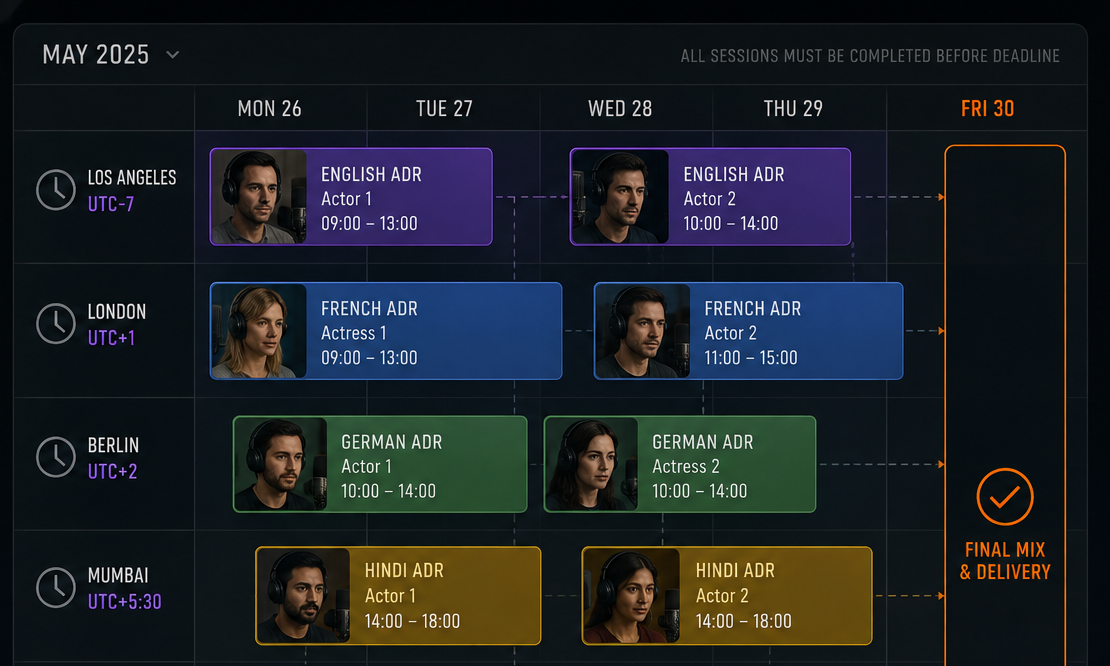
For years, the mix was where localization projects lived or died — get the dialogue, music, and effects balanced right, and the rest fell into place. That’s no longer where the real pressure sits. On a growing number of global day-and-date releases, the project doesn’t stall in the mix room. It stalls before anyone even picks up a fader, in the scramble to get the right actors into the right booth at the right time.
The Real Constraint Isn’t Talent. It’s Calendars.
ADR scheduling has always required coordinating actor availability, studio time, and director sign-off. What’s changed is the timeline it now has to fit into. Simultaneous global releases compress delivery windows so tightly that dubbed versions often need to be locked days before the actual air date, just to leave room for a full quality pass rather than a spot check. That buffer window is non-negotiable for quality — which means all the scheduling slack has to come out of ADR instead.
Multiply that by a title releasing across a dozen-plus territories, each with its own cast, director, and studio calendar, and ADR scheduling stops being an administrative task. It becomes the critical path. A single unavailable actor in one market can hold up delivery for that entire language, even when every other territory is done.
Remote Recording Solved Access. It Didn’t Solve Timing.
Remote ADR made it possible to record actors from anywhere, which helped with geographic availability. But remote access doesn’t fix the underlying calendar problem — an actor who’s booked on another production, in a different time zone, with a tight window between projects, is still a scheduling conflict whether they’re walking into a physical booth or logging into a remote session. If anything, remote workflows have made more territories viable to book quickly, which increases the number of calendars a studio has to align simultaneously, not fewer.
Projects with tight multi-territory turnarounds bear this out in practice. One well-documented case involved localizing a series across 17 subtitling languages and three dubbing languages under Netflix’s simultaneous-release standards — a project ZOO Digital’s case study describes as needing to be “super-efficient from the start” precisely because of how many territories had to land on the same delivery date. That kind of scale isn’t unusual anymore — it’s becoming the default expectation for major streaming titles.
What Studios Are Doing About It
The teams handling this well aren’t just booking sessions faster — they’re restructuring how far in advance ADR gets planned. That means locking actor availability before the final script is even finished, building in pre-negotiated backup casting for high-risk roles, and treating ADR calendars as a shared planning document across every territory rather than a per-language afterthought. Some studios are also shifting more sessions earlier in the pipeline, recording against locked picture sooner so ADR isn’t competing with final mix for the same shrinking window.
None of this makes the mix stage less important. It does mean the mix is no longer the stage most likely to blow a deadline. As release windows keep compressing, the studios that stay on schedule will be the ones that solved the actor-availability problem weeks before anyone booked a mix suite.


