
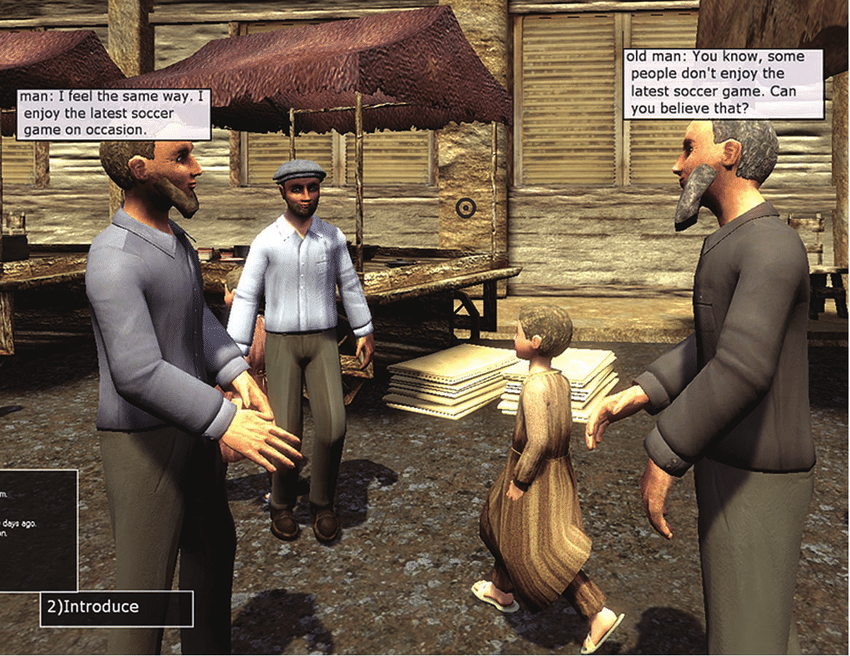
Open-world games are becoming louder, denser, and more reactive than ever before. Modern titles no longer rely only on scripted dialogue and cinematic scenes to build immersion. Instead, much of the realism now comes from ambient NPC crowd chatter, reactive crowd systems, and dynamic background conversations that make game worlds feel alive; but behind that realism is a growing problem.
As crowd systems become more complex, studios are discovering that NPC ambient audio is creating entirely new production bottlenecks—especially for multilingual releases.
Crowd audio is no longer simple background noise
In older games, crowd audio was often generic and repetitive:
- looping market sounds
- random murmurs
- non-specific background voices
Today’s systems are far more advanced.
Modern NPC crowds react dynamically to:
- player reputation
- combat events
- weather changes
- quest progression
- nearby actions
- time of day
Characters may comment on crimes, react to explosions, gossip about story events, or respond to player decisions in real time.
This creates worlds that feel socially reactive—but also dramatically increases localization complexity.
Instead of localizing a limited set of ambient lines, teams may now handle thousands of reactive voice fragments across multiple systems.
Reactive barks create scaling problems
One major issue comes from “barks”—short reactive NPC lines triggered dynamically during gameplay.
A single open-world district may contain:
- combat reactions
- greetings
- warnings
- panic responses
- contextual jokes
- crowd gossip
- environmental comments
And unlike cinematic dialogue, these lines often trigger unpredictably.
This creates problems for localization because:
- lines may overlap with gameplay audio
- context may be unclear during recording
- emotional tone changes rapidly
- playback timing varies across languages
A bark that sounds natural in English may feel too long, too loud, or emotionally mismatched in another language.
At scale, even small issues become noticeable because players hear crowd systems constantly throughout gameplay.
Open-world realism requires more variation
To avoid repetition, studios are recording increasingly large pools of crowd dialogue variations.
This improves immersion, but multiplies localization demands.
Instead of recording:
- one market reaction
or - one combat warning
teams may now need dozens of alternate localized versions for the same event.
For multilingual projects, this creates pressure across:
- translation
- casting
- voice recording
- implementation
- QA testing
The challenge becomes even larger in live-service games where new events and seasonal content constantly introduce fresh NPC reactions.
As explored in Force Media article:, dynamic systems already complicate dialogue workflows. Crowd audio expands this challenge into massive environmental scale.
Why implementation is becoming the real bottleneck
In many cases, the biggest problem is no longer recording—it is implementation management.
Crowd systems rely heavily on:
- trigger logic
- spatial audio behavior
- playback priority systems
- environmental mixing
- conditional dialogue states
This means localization teams increasingly need to collaborate with:
- AI behavior designers
- audio implementers
- systems engineers
- open-world narrative teams
Without strong coordination, localized crowd systems can quickly become chaotic:
- overlapping dialogue
- repetitive lines
- mismatched emotional reactions
- broken timing
- immersion-breaking audio density
As crowd systems become smarter, localization workflows must become more systemic as well.
The future of ambient localization
NPC crowds are evolving from background texture into active storytelling systems.
Players now expect cities, towns, and social spaces to feel reactive and alive—and much of that realism comes through audio. Building believable crowd systems across multiple languages is becoming one of the most resource-intensive challenges in modern gamedev.
The studios that solve it successfully will be the ones that treat crowd audio as part of core worldbuilding, not secondary ambience.


