
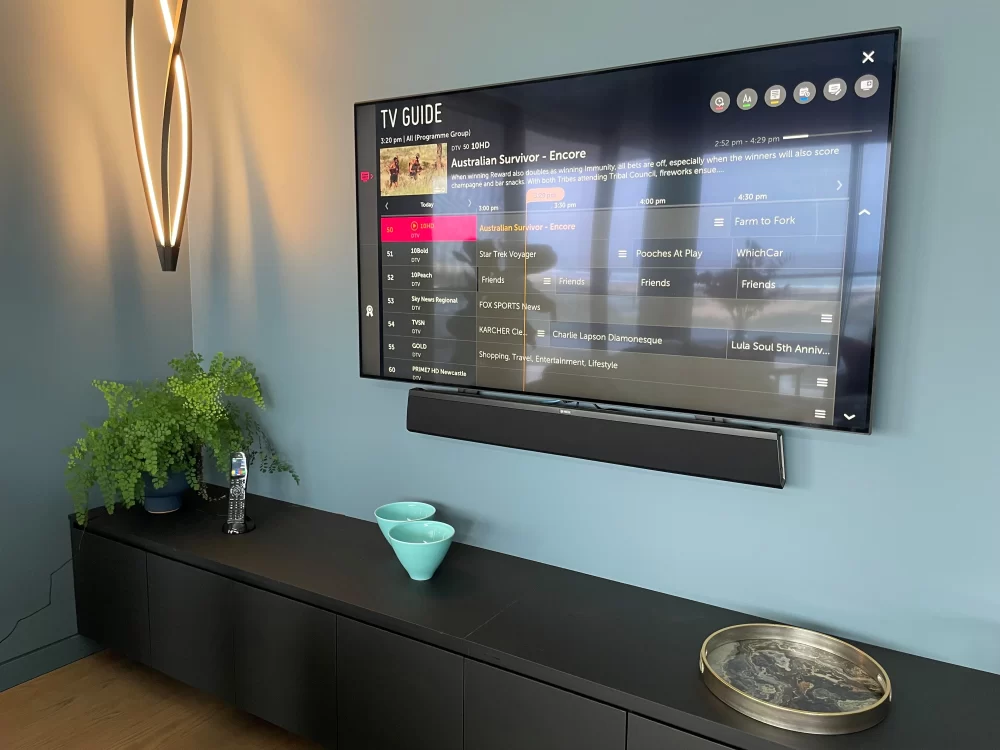
Streaming audio is evolving fast—and not just because of HDR or spatial formats. The real shift is happening in living rooms, where soundbars have become the dominant playback system.
As more viewers rely on compact, virtualized audio setups instead of full surround systems, mixers are rethinking how content translates outside the studio. This is quietly reshaping how streaming mixes are built.
The rise of soundbar-first playback
For years, home audio standards were based on multi-speaker surround systems. Today, that assumption no longer holds.
Most streaming audiences now experience content through:
- soundbars
- TV speakers with virtual surround
- headphones and earbuds
Soundbars, in particular, have become the closest thing to a “premium default,” often using virtualized Atmos processing and multi-channel simulation to recreate cinematic sound without physical speakers.
For mixers, this creates a new reality: even high-end content is often heard through a compressed, front-loaded soundstage.
Why center channel dialogue needs rethinking
Traditional mixing workflows treat the center channel as the anchor for dialogue. In theatrical environments, this ensures clarity and stability.
But soundbars don’t reproduce the center channel in the same way.
Many systems:
- simulate a center channel using left/right speakers
- or digitally process dialogue to “sit” in the middle
This can lead to inconsistent results. Dialogue may feel less defined or even unnatural depending on the system, especially when center information is artificially reconstructed.
As a result, mixers are increasingly:
- refining midrange clarity
- reducing masking from music and effects
- testing dialogue across real consumer setups
Dialogue is no longer just about placement—it’s about translation across imperfect playback systems.
Bass translation is becoming a critical challenge
Low-end design is another area heavily affected by soundbars.
Unlike full-range theatrical systems, many soundbars:
- limit sub-bass extension
- compress dynamic low frequencies
- exaggerate certain bass bands to simulate impact
This means a mix that feels powerful in the studio may sound weak—or overly boomy—on consumer playback.
To adapt, mixers are focusing on:
- harmonic layering for perceived bass weight
- tighter dynamic control
- more consistent low-frequency balance
The goal is no longer pure depth, but consistent impact across devices.
Atmos virtualization is changing spatial decisions
Dolby Atmos is widely supported across streaming platforms, but in most homes it is experienced through virtualization, not true speaker arrays.
Soundbars simulate height and surround channels using:
- up-firing drivers
- wall reflections
- psychoacoustic processing
This can reduce spatial precision, with overhead and rear elements often collapsing into the front soundstage.
As a result, mixers are:
- simplifying spatial complexity
- emphasizing key directional moments
- ensuring core elements remain clear without full Atmos separation
Immersive audio is no longer about perfect positioning—it’s about perceived immersion on limited systems.
The new reality of streaming audio
Soundbars are not a limitation—they are the new baseline.
As explored in our article: Why HDR Audio Is Becoming the New Standard in Streaming, platforms are pushing for more dynamic and cinematic sound. But achieving that quality now depends on how well mixes translate to real-world playback.
At the same time, our previous article discussed the growing need to test beyond ideal studio environments; which leads to one main conclusion:
Streaming mixes are no longer built for perfect systems—they are built for probable ones.
For post-production teams, this means designing audio that works across soundbars, headphones, and TVs—not just calibrated stages. Because today, the success of a mix isn’t defined in the studio.
It’s defined in the living room.


