
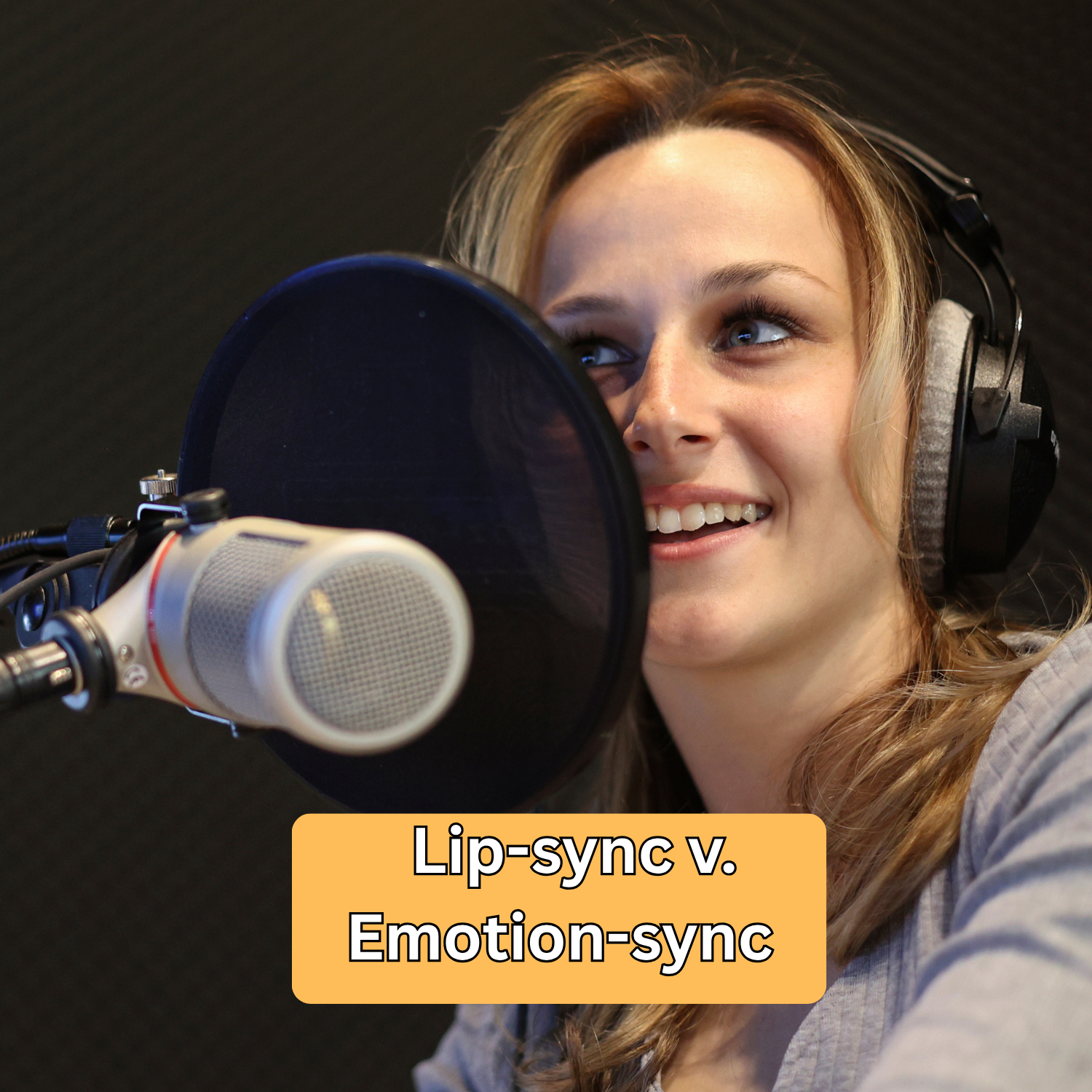
When it comes to dubbing, audiences notice two things right away — how well the voice fits the character, and whether it feels right. Lip-sync may seem like the top priority, but emotional sync — the ability of the voice performance to match the tone, rhythm, and emotion of the original — is what truly makes or breaks a localized production. Let’s break down why both matter, and why the best dubbing finds harmony between precision and performance.
Lip-Sync: The Technical Art of Alignment
Lip-sync refers to how closely dubbed dialogue matches the mouth movements of the on-screen actor. It’s a vital part of making the illusion believable, especially in live-action productions, where mismatched timing can immediately pull viewers out of the story.
A well-synced line isn’t just about timing. It’s about phonetics, pacing, and rhythm. Skilled adaptors often rework translations to match the shape of the actor’s mouth — ensuring open vowels, plosives, and pauses line up naturally.
Tools like phoneme alignment software and AI-driven sync correction now make this process faster and more precise, saving engineers countless hours of manual tweaking. But even with advanced tech, perfect lip-sync alone isn’t enough.
Emotional Sync: The Soul of Localization
While lip-sync keeps the illusion intact, emotional sync keeps the audience engaged. It’s about capturing the intent and feeling of the original performance — not just mirroring words, but replicating the actor’s emotional state through voice, tone, and rhythm.
A perfectly synced line that lacks emotional weight can sound robotic or disconnected. On the other hand, a line that’s a frame off but emotionally authentic still feels real and resonant. That’s why professional dubbing studios often prioritize performance over mechanical precision.
This balance is especially crucial in genres that depend on subtlety — dramas, animation, and character-driven games. A whisper, laugh, or sigh carries emotional cues that define a moment’s impact more than flawless timing does.
When Lip-Sync Takes the Lead
Of course, there are cases where lip-sync is non-negotiable. In live-action films or TV series, visible mouth flaps require near-perfect alignment to maintain immersion.
In these scenarios, dialogue adapters and voice directors often make creative compromises. They may adjust phrasing, shorten lines, or shift emphasis slightly to preserve timing without losing meaning. It’s a delicate dance between technical accuracy and narrative truth.
High-profile streaming releases have made these standards even stricter. Platforms like Netflix and Disney+ expect global dubs that are not only linguistically precise but visually seamless. For many studios, achieving that level of sync has become a competitive benchmark.
When Emotion Rules the Mix
In animation and video games, however, emotional sync often comes first. Animated mouths or digital avatars allow more freedom — and with that freedom comes greater responsibility for performance authenticity.
For example, in anime localization, voice actors are often encouraged to match the emotional temperature of a scene, even if it means deviating slightly from perfect sync. The audience will forgive a one-frame lag — but not a performance that sounds flat or mismatched.
The same applies to cinematic games and interactive media, where player immersion depends on believable, emotionally charged voice work. Great dubbing in these cases is about feeling, not just fitting.
The Future: AI Tools Meet Human Emotion
AI-assisted lip-sync is becoming more advanced every year, using machine learning to map phoneme patterns and automatically align dubbed voices. These tools can drastically reduce time in post-production — but they can’t yet replace the human understanding of emotion and cultural nuance.
That’s where skilled directors, localization specialists, and voice actors still lead. The most impactful dubbing combines the efficiency of AI with the artistry of human performance.


