
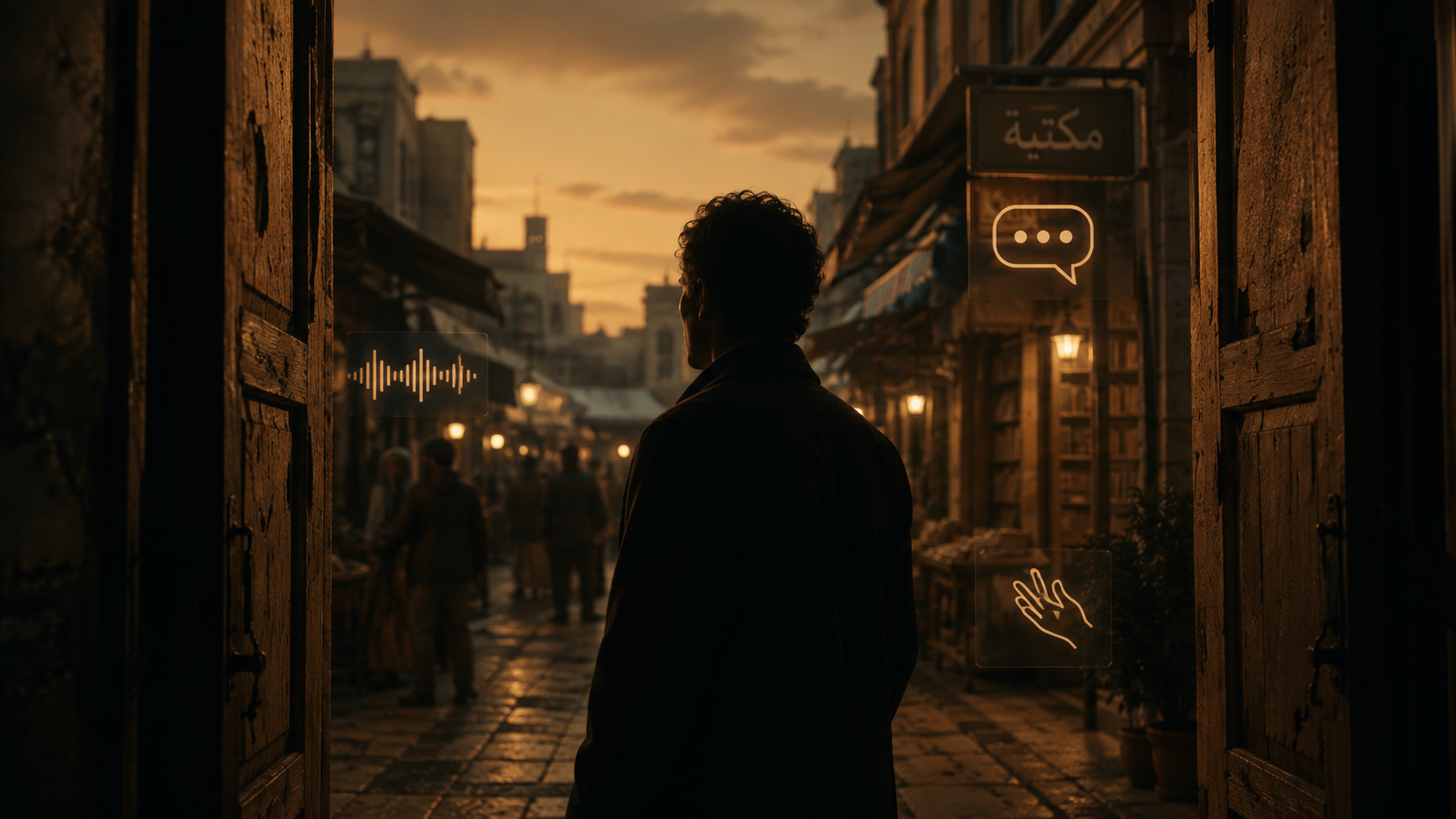
Not every scene needs a translator, but almost every scene still needs a localization decision. Imagine – a character walks through a market with no lines, a hand reaches for a door with a sign on it, a room falls quiet after an argument. There’s no dialogue to dub, no subtitle to time, but these are often the scenes localization teams spend the most careful attention on, because the absence of speech doesn’t mean the absence of meaning. It just means the meaning is carried by something other than words.
Ambient Sound Isn’t Neutral
A “silent” scene is rarely actually silent. It’s built from ambient sound — traffic, birdsong, market chatter, a distant call to prayer, background conversation in a café. All of that ambience is culturally specific, and localization teams have to decide, scene by scene, whether to preserve it as-is or adapt it for a target audience.
Background chatter recorded in the original language can pull a foreign-language viewer’s attention in the wrong direction, especially if it’s mixed loud enough to half-register as dialogue. Some studios choose to duck it further in localized versions; others replace it with generic walla in the target language so it reads as ambient noise rather than a competing conversation. Neither choice is automatic — it depends on the scene, the mix, and how much the ambience is doing narratively.
On-Screen Text: The Silent Line Nobody Budgets For
A street sign, a text message, a note left on a table, a computer screen with a warning message — these carry story information the audience needs, and they’re easy to miss in a localization budget precisely because there’s no dialogue attached to them. Some are handled with subtitled overlays, some with redrawn graphics, some left untouched because the visual is understandable without translation. Getting this wrong doesn’t just look sloppy: it can quietly cut non-native audiences out of plot information that dialogue-driven viewers get for free.
Studios that handle this well flag on-screen text during the localization script pass — not as an afterthought during QC, but as its own checklist item alongside dialogue and lyrics.
Gestures Don’t Translate Themselves Either
A nod, a hand gesture, a moment of prolonged eye contact — gestures read differently across cultures, and a silent beat that lands as “tender” in one market can read as “awkward” or even mean something entirely different in another. Localization teams can’t redraw a performance, but they can flag scenes where a gesture is likely to be misread and work with directors on framing choices, added ambient cues, or, in rare cases, additional context elsewhere in the localized version to bridge the gap.
Why This Deserves a Line Item, Not an Afterthought
Silent scenes get skipped in localization planning because there’s no script line to check off. But ambient sound, on-screen text, and gestural meaning are all doing narrative work that dialogue would otherwise carry — and treating them as automatically “done” once the dialogue is dubbed is how studios end up with polished conversations sitting inside scenes that quietly lose meaning in translation. The best localization teams treat silence as content, not a gap.


